
Why Does Pet Food Packaging Get Damaged During Transportation?
6/26/20263 min read
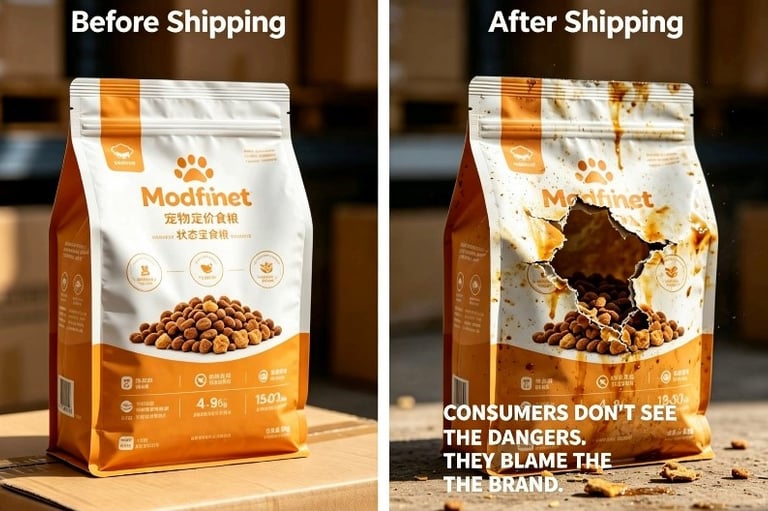
Many pet food brands have encountered this issue: the packaging leaves the factory in perfect condition, but by the time it reaches distributors or consumers, the bags are torn, leaking, or even the entire carton is stained with oil and grease.
Logistics damage is the most hidden cost black hole for pet food brands.
A damaged bag is not just a matter of replacing one unit.
It means: return costs, reshipping costs, loss of customer trust, and channel penalties.
Consumers won't blame the courier — they'll blame your brand.
Damage ≠ Accident
This is a problem that is very easily misattributed. Many brands think that "shipping damage is the courier company's fault," but in reality, 90% of the root causes lie in the packaging design phase.
Shipping damage typically occurs in three stages:
Loading, unloading, and sorting – damage caused by drop impact, accounting for approximately 50%
Stacking and warehousing – crushing and deformation caused by prolonged compression, accounting for approximately 30%
In-transit vibration – seal opening or zipper failure caused by continuous vibration, accounting for approximately 20%
The problem usually comes down to three areas:
I. Insufficient Heat Seal Strength
The seal is the weakest point of the entire bag. Many dry food bags have a heat seal strength of only 20–25 N/15mm, which may look "sufficient" in static testing.
But in actual transit:
Impact force concentrates at the seal corners during drops
Bottom seals endure sustained pressure during stacking
Seals are subjected to repeated stress during vibration
When heat seal strength falls below 30 N/15mm, the risk of shipping damage increases significantly.
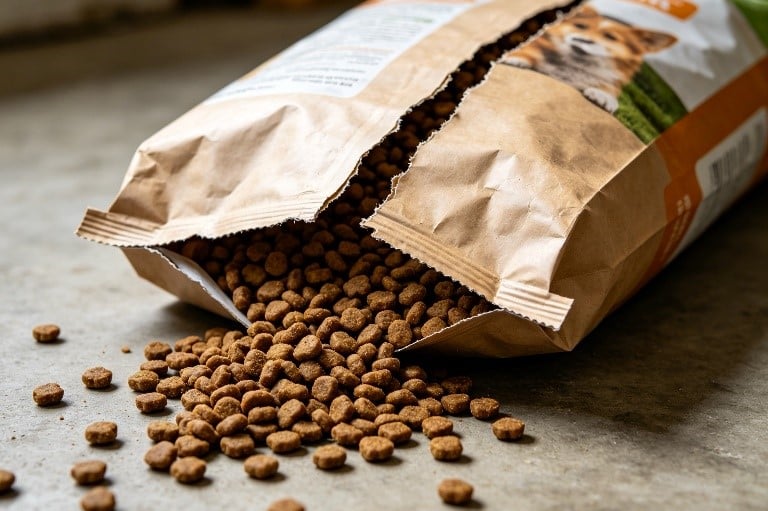
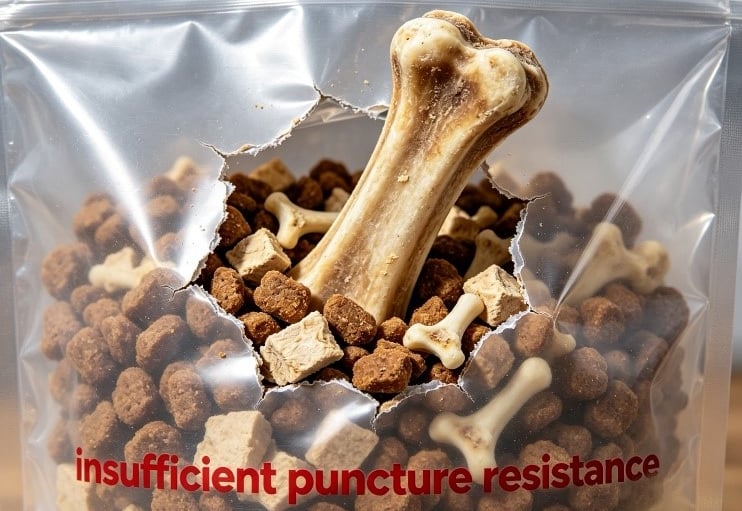
II. Insufficient Puncture Resistance (Especially Critical for Bones and Freeze-Dried Products)
This is a pitfall that many brands have stumbled into.
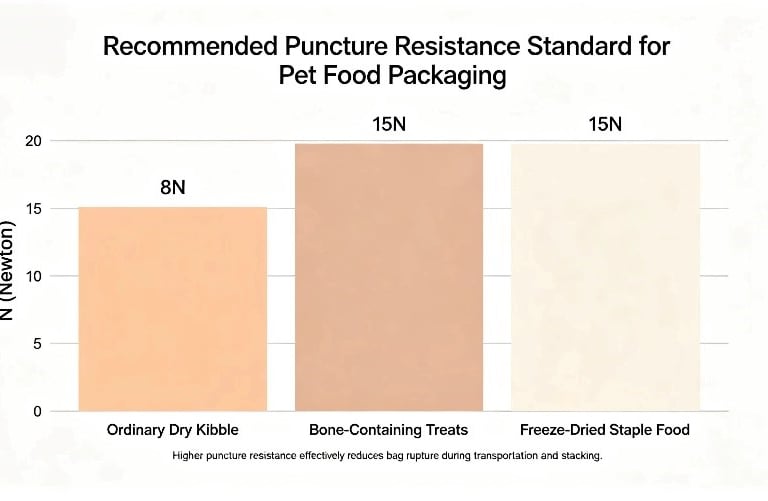
A standard PET/PE structure offers a puncture resistance of only 5–8N.
However:
The sharp edges of freeze-dried chicken breast can generate over 15N of puncture force
The corners and edges of bone-shaped treats are even more likely to pierce through
Compression during transit further amplifies the puncture risk
Picture 3:Recommended puncture resistance levels:
III. Mismatch Between Bag Type and Stacking Method
This is the most common — and most easily overlooked — issue.
Different bag types show significant differences in stacking stability:
Three-side seal bags – poor stacking stability, prone to slipping and deformation
Stand-up pouches – moderate stability, with certain requirements for bottom structure
Eight-side seal bags – best stability, capable of stacking 5 layers or more
Gusseted bags – side panels prone to bulging, higher stacking risk
Many brands use three-side seal bags for 2kg dry food, and deformation starts at just 3 layers high.
Result: Bottom bags get crushed → seals crack → air leakage / product spillage.
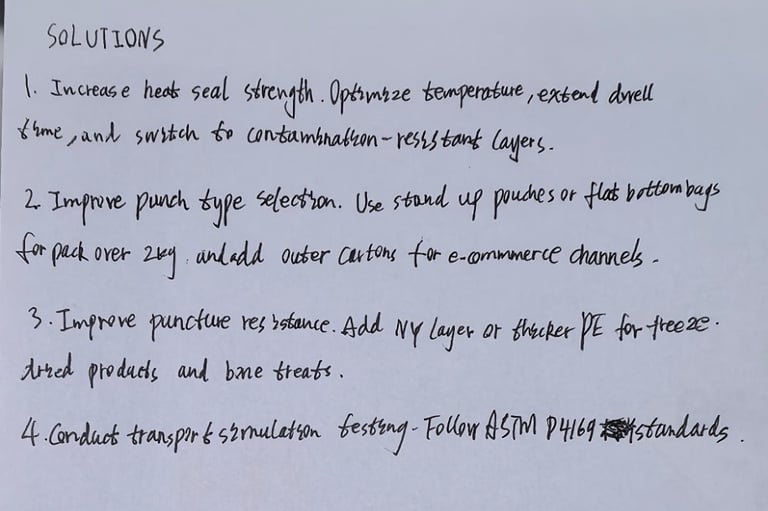
IV. Solutions
Improve heat seal strength. Optimize sealing temperature, extend dwell time, switch to contamination-resistant sealant layers.
Enhance puncture resistance. For freeze-dried and bone-containing treats, add a NY (nylon) layer or thicken the PE layer.
Optimize bag type selection. For products over 2kg, use stand-up pouches or eight-side seal bags; add an outer carton for e-commerce channels.
Conduct transport simulation testing. Perform verification testing prior to mass production in accordance with ASTM D4169 or ISTA 3A standards.
Packaging that is "intact upon leaving the factory" is not enough — it must survive the entire journey from the factory to the consumer's hands.
© 2026 LX PetFoodBag Manufacturing. All rights reserved.


Professional pet food packaging manufacturer with a 25,000㎡ facility and advanced printing technology. Delivering premium custom packaging solutions to global brands since 2010.
Contact
ADD: 123 Packaging Way,
Industrial District,
Guangdong. China
TEL : +8613380674348